2666
Autorretratos en la literatura de Bolaño

(jueves, 10 de agosto de 2023, 18:54:40; fecha del archivo en Word de la transcripción)
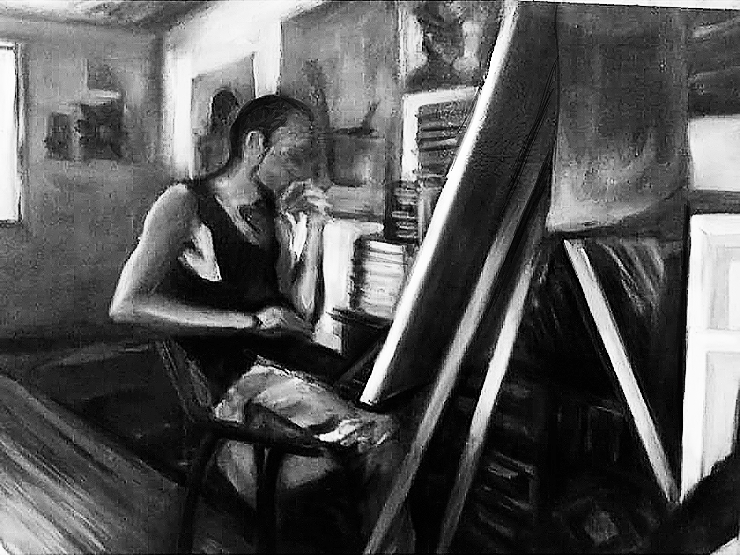
Atelier, selfportrait
Oil on cardboard, estudio
A4
(Not Avaible, no existe)
Este estudio de autorretrato sobre cartón fue parte de una serie de estudios que se tituló Nocturnos, era una serie de más o menos 20 piezas que incluía escenas de interior como de vida nocturna social callejera. De esos estudios sólo se conserva el muy mal registro de un par de ellos – «We are the nigth», es un registro que también se conservó- Son registros de redes pero que fueron rescatados desde formatos de screenshot, y por eso son imágenes de muy baja calidad o resolución.
(This self-portrait study on cardboard was part of a series of studies titled Nocturnes (Nocturnos), a collection of roughly twenty pieces that featured both interior scenes and nighttime street life. Of these studies, only a very low-quality record of a few survives—We are the night being one of the preserved documentations. These are social media records rescued from screenshots, which is why they are low-resolution images.)
2666
La primera vez que Jean-Claude Pelletier leyó a Benno von Archimboldi fue en la navidad de 1980,…a la edad de diecinueve años. El libro en cuestión era D’Arsonval. El joven Pelletier ignoraba entonces que esa novela era parte de una trilogía (compuesta por El jardín, de tema inglés, La máscara de cuero, de tema polaco, así como D’Arsonval, era, evidentemente, de tema francés) …
A partir de ese día (o de las altas horas nocturnas en que dio por finalizada aquella lectura inaugural) se convirtió en archimboldiano entusiasta y dio comienzo su peregrinaje en busca de más obras de dicho autor. No fue tarea fácil… Sus profesores no habían oído hablar de él. Uno de ellos le dijo que su nombre le sonaba de algo. Con furor (con espanto) Pelletier descubrió al cabo de diez minutos que lo que le sonaba a su profesor era el pintor italiano, hacia el cual, por otra parte, su ignorancia también se extendía de forma olímpica.
Escribió a la editorial de Hamburgo que había publicado D’Arsonval y jamás recibió respuesta…El nombre de Archimboldi aparecía en un diccionario sobre literatura alemana y en una revista belga dedicada, nunca supo si en broma o en serio, a la literatura prusiana. En 1981 viajó, junto con tres amigos de facultad, por Baviera y allí, en una pequeña librería de Munich, en Voralmtrasse, encontró otros dos libros, el delgado tomo de menos de cien páginas titulado El tesoro de Mitzi y el ya mencionado El jardín, la novela inglesa.
La lectura de estos dos nuevos libros contribuyó a fortalecer la opinión que ya tenía de Archimboldi. En 1883, a los 22 años, dio comienzo a la tarea de traducir D’Arsonval. Nadie le pidió que lo hiciera. No había entonces ninguna editorial francesa interesada en publicar a ese alemán de nombre extraño. Pelletier empezó a traducirlo básicamente porque le gustaba, porque era feliz haciéndolo, aunque también pensó que podía presentar esa traducción, precedida por un estudio sobre la obra archimboldiana, como tesis y, quien sabe, como primera piedra de su futuro doctorado.
Acabó la versión definitiva de la traducción en 1984 y una editorial parisina, tras algunas vacilantes y contradictorias lecturas, la aceptó y publicaron a Archimboldi, cuya novela, destinada a priori a no superar la cifra de mil ejemplares vendidos, agotó tras un par de reseñas contradictorias, positivas, incluso excesivas, los tres mil ejemplares de tirada abriendo las puertas de una segunda y tercera y cuarta edición.
Manuel Espinoza llegó a Archimboldi por otros caminos. Más joven que Morini y que Pelletier, Espinoza no estudió al menos durante los dos primeros años de su carrera universitaria, filología alemana sino filología española, entre otras tristes razones porque Espinoza soñaba con ser escritor. De la literatura alemana sólo conocía (y mal) a tres clásicos, Hölderlin, porque a los dieciséis años creyó que su destino estaba en la poesía y devoraba todos los libros de poesía a su alcance, Goethe, porque en el último año del instituto un profesor humorista le recomendó que leyera Werther, en donde encontraría un alma gemela, y Schiller, del que había leído una obra de teatro. Después frecuentaría la obra de un autor moderno, Jünger, más que nada por simbiosis, pues los escritores madrileños que odiaba con toda su alma hablaban de Jünger sin parar. Así que se puede decir que Espinoza solo conocía a un autor alemán y ese autor era Jünger. Al principio, la obra de éste le pareció magnífica, y como gran parte de sus libros estaban traducidos al español, Espinoza no tuvo problemas en encontrarlos y leerlos todos. A él le hubiera gustado que no fuera tan fácil. La gente a la que frecuentaba, por otra parte, no sólo eran devotos de Jünger sino que algunos de ellos también eran sus traductores, algo que a Espinoza le traía sin cuidado, pues el brillo que él codiciaba no era el de traductor sino el de escritor…
Siguió, pues, en la Universidad, estudiando filología española, pero al mismo tiempo se matriculó en filología alemana. Dormía entre cuatro y cinco horas diarias y el resto del día lo invertía en estudiar. Antes de terminar filología alemana escribió un ensayo de veinte páginas sobre la relación entre Werther y la música, que fue publicada en una revista literaria madrileña y en una revista universitaria de Gottingen. A los veinticinco años había terminado ambas carreras. En 1990, alcanzó el doctorado en literatura alemana con un trabajo sobre Benno von Archimboldi que una editorial barcelonesa publicaría un año después. Para entonces Espinoza era un habitual de congresos y mesas redondas sobre literatura alemana. Nunca tradujo a Archimboldi ni a ningún otro autor alemán.
Aparte de Archimboldi una cosa tenían en común Morini, Pelletier y Espinoza. Los tres poseían una voluntad de hierro.
2666
The first time Jean-Claude Pelletier read Benno von Archimboldi was at Christmas in 1980,…at the age of nineteen. The book in question was D’Arsonval. The young Pelletier was unaware at the time that this novel was part of a trilogy (composed of The Garden, of English theme, The Leather Mask, of Polish theme, just as D’Arsonval was, evidently, of French theme)…
From that day on (or from the late night hours when he finished that inaugural reading) he became an enthusiastic Archimboldian and began his pilgrimage in search of more works by the said author. It was no easy task… His professors had never heard of him. One of them told him the name sounded vaguely familiar. With fury (with dread) Pelletier discovered after ten minutes that what sounded familiar to his professor was the Italian painter, toward whom, moreover, his ignorance was equally majestic.
He wrote to the publishing house in Hamburg that had published D’Arsonval and never received a reply… Archimboldi’s name appeared in a dictionary of German literature and in a Belgian journal dedicated, though he never knew whether in jest or in earnest, to Prussian literature. In 1981 he traveled through Bavaria with three college friends, and there, in a small bookstore in Munich on Voralmtrasse, he found two other books: the slim volume of less than a hundred pages titled Mitzi’s Treasure and the aforementioned The Garden, the English novel.
The reading of these two new books served to reinforce the opinion he already held of Archimboldi. In 1883 [sic], at the age of 22, he undertook the task of translating D’Arsonval. No one asked him to do it. There was no French publishing house interested at the time in publishing that German with the strange name. Pelletier began translating it basically because he liked it, because it made him happy to do so, though he also thought he might present the translation, preceded by a study on Archimboldian work, as a thesis and, who knows, as the cornerstone of his future doctorate.
He finished the final version of the translation in 1984, and a Parisian publishing house, after some hesitant and contradictory readings, accepted it and published Archimboldi. The novel, which a priori was destined not to exceed a thousand copies sold, went through its three-thousand-copy print run after a couple of contradictory, positive, even excessive reviews, opening the doors to a second, third, and fourth edition.
Manuel Espinoza arrived at Archimboldi by other paths. Younger than Morini and Pelletier, Espinoza did not study German philology, at least during the first two years of his university career, but rather Spanish philology, among other sad reasons because Espinoza dreamed of being a writer. Of German literature he knew only (and poorly) three classics: Hölderlin, because at sixteen he believed his destiny lay in poetry and devoured every poetry book within his reach; Goethe, because in his final year of high school a whimsical teacher recommended he read Werther, where he would find a kindred soul; and Schiller, of whose work he had read a play. Afterward he would frequent the work of a modern author, Jünger, more than anything by osmosis, because the Madrid writers he loathed with all his soul talked about Jünger incessantly. So it could be said that Espinoza knew only one German author, and that author was Jünger. At first, his work seemed magnificent to him, and since most of his books were translated into Spanish, Espinoza had no trouble finding and reading them all. He would have preferred it not to be so easy. The people he hung out with, on the other hand, were not only devotees of Jünger but some of them were also his translators, something that left Espinoza cold, since the brilliance he coveted was not that of a translator but of a writer…
He continued, then, at the university, studying Spanish philology, but at the same time he enrolled in German philology. He slept between four and five hours a day, and the rest of his time was spent studying. Before finishing German philology, he wrote a twenty-page essay on the relationship between Werther and music, which was published in a Madrid literary magazine and a university journal in Göttingen. By the age of twenty-five he had completed both degrees. In 1990, he earned his doctorate in German literature with a thesis on Benno von Archimboldi that a Barcelona publisher would release a year later. By then Espinoza was a regular at conferences and round tables on German literature. He never translated Archimboldi or any other German author.
Aside from Archimboldi, Morini, Pelletier, and Espinoza had one thing in common. All three possessed an iron will.
