

ESSAY
ENSAYO

Este trabajo literario es una suerte de mapa temático o índice de contenidos para un futuro ensayo respecto de la historiografía del cristianismo. No se puede tratar de entender la historia del cristianismo en occidente sin conocer de qué va el judaísmo o las tradiciones hebreas todas desprendidas desde su cosmovisión religiosa, como tampoco se puede entender o hablar de monoteísmo con propiedad, sin tener un conocimiento claro del judaísmo. O como ya lo he planteado en otras instancias: cuando hablamos del Dios cristiano o de religión cristiana, sí o sí, nos estamos refiriendo al D ios hebreo; esto, independiente de que el creyente contemporáneo -o católico o protestante- no se entere ni sepa hacer la salvedad de que su religión cristiana deriva de una tradición hebraica, el creyente o feligrés, sí o sí, siempre, estará adorando al Dios de los judíos.
Este índice temático lo desarrollé a fines del año 2024, y surge de múltiples investigaciones e intereses personales respecto del monoteísmo, judaísmo, islamismo y cristianismo. El proyecto como ensayo es una propuesta ambiciosa, y de seguro tomará varios años desarrollarlo con la seriedad intelectual que el tema me inspira. Ya he ido desarrollando y redactando contenidos y cuartillas de manera aleatoria, y espero poder presentar al lector el desarrollo de los primeros contenidos propuestos dentro de los meses siguientes o a principios del año próximo.
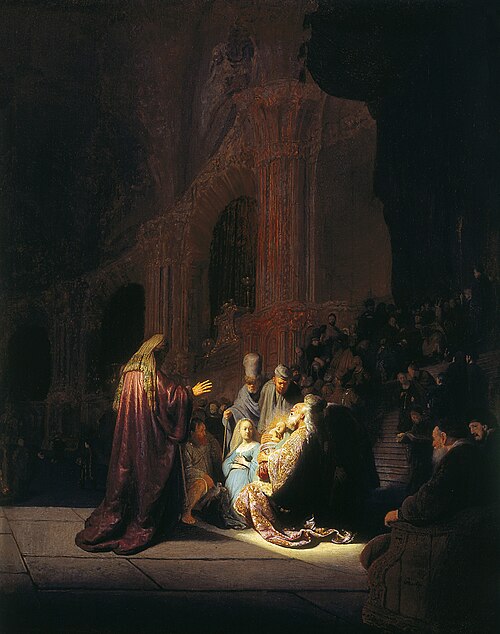
Rembrandt van Rijn, Presentación de Jesús en el Templo, 1631, óleo sobre roble, 60, 9 cm x 47,9 cm
DE LA HISTORIA DEL CRISTIANISMO.
1.- La figura del Cristo o Mesías en la tradición judeo-hebraica.
a.- Las prefiguraciones del Mesías en el Tanaj (Antiguo testamento: Pentateuco-Los profetas Mayores y menores- Libros históricos- Literatura poética)
b.- El Mesías como sumatoria de todos los caudillos y profetas del Tanaj
c.- Exégesis de la literatura profética en el Tanaj respecto de la figura del Mesías.
2.- El Mesías enfrentado a la institucionalidad del judaísmo bajo el dominio romano.
a.- El Cristo enfrentado al sanedrín.
b.- La doctrina del Cristo.
c.- El carácter de los apóstoles:
¿Por qué el Cristo eligió cómo apóstoles a quiénes eligió?
d.- El Cristo crucificado, el velo rasgado, el cisma en la tradición judaica y rabínica.
3.- Surgimiento del Cristianismo como nuevo monoteísmo.
a.- La Iglesia Primitiva o El nacimiento del cristianismo y el concepto de evangelio.
a. 1. (La doctrina del Cristo y sus discursos no tendrán jamás relación alguna con conceptos del comunismo, como han querido proponer filósofos amateurs contemporáneos y comentaristas, como contraargumento demagógico y político al capitalismo desregulado.)
b.- La Persecución de la Iglesia Primitiva.
c.- La Romanización, apropiación y adecuación del cristianismo como intento desesperado de un imperio en decadencia.
d-. La aparición de la Iglesia Católica Apostólica y Romana: La institución.
4.- Las Falacias del canon católico romano
a.- Pedro no fundó la Iglesia Católica apostólica romana.
b.- La falacia de la figurilla del papa como representante de Dios en la Tierra.
c.- La Iglesia católica como institución que se superpone al estado, incluso al rey, cuando existe monarquía.
d.- La vida de monasterio:
d. 1.- El canto gregoriano y su aportación al desarrollo de la teorización de la música occidental: la música como arte estético.
d. 2. – La transcripción de manuscritos. La caligrafía. La tradición literaria monástica.
d. 3.- Las falacias del dogma católico:
d. 3. 1.- Las leyendas de la vida de los apóstoles.
d. 3. 2.- La venta de la bula eclesiástico.
d. 3. 3.- La quema de libros, la persecución de la ciencia y sus intelectuales y librepensadores.
d.4 Los crímenes de la Iglesia Católica.
d. 3. 5. – La inquisición: la quema de «brujas», la excomunión.
Cisma en la Iglesia: La Reforma Luteranas. Las 95 tesis de Lutero.
a. – El surgimiento del Protestantismo.
b. – El anglicanismo.
La Contrarreforma: Surgimiento del Barroco Italiano Pictórico como método publicitario.
(Las grandes obras maestras de la historia de la Pintura.)
6.- La acumulación de tierras, oro, obras de arte en el Vaticano producto de la corrupción de la institución.
7.- La homosexualidad y la Pedofilia en la Iglesia Católica como un ejercicio de perversión constante: ¿Puede desde aquí la iglesia católica arrogarse el derecho de ser «la iglesia de dios»?
a.- Los escándalos y crímenes de pedofilia por el eclesiástico hasta el día de hoy: el encubrimiento de la iglesia frente al poder judicial.
8.- La Canonización como deporte de chabacanería.
8.- a. El misionerismo en América.
b. El sincretismo como producto del misionerismo: la idolatría y el paganismo superando sus anteriores estados de ignorancia y superchería.
9.- El papado de Francisco, Mario Bergoglio
a.- Las apostasías de Francisco.
El Protestantismo en América.
La liturgia, ¿de dónde nace?
El Dios Trinitario.
El diezmo como negocio. («No observamos la Ley, porque Cristo superó la Ley, pero sí conservamos el diezmo.)
El concepto del Pastor.
La corrupción del diezmo.
La emocionalidad y la teatralidad por encima de las escrituras.
La chabacanería de los cultos protestantes en América Latina.
…
Miércoles, 11 de diciembre de 2024, 12:39:48
HISTORY OF CHRISTIANITY
This literary work serves as a thematic roadmap or outline of contents for a forthcoming essay on the historiography of Christianity. One cannot attempt to understand the history of Western Christianity without grasping the essence of Judaism and the various Hebrew traditions derived from its religious worldview; nor can one discuss monotheism with proper rigor without a clear knowledge of Judaism. Or, as I have posited on other occasions: whenever we speak of the Christian God or the Christian religion, we are inescapably referring to the Hebrew God. Regardless of whether the contemporary believer—be it Catholic or Protestant—is unaware of or fails to recognize that their Christian faith derives from a Hebraic tradition, the worshiper is, inevitably and always, adoring the God of the Jews.
This thematic index was developed in late 2024, arising from extensive personal research and a deep interest in monotheism, Judaism, Islam, and Christianity. As an essay project, it is an ambitious undertaking, one that will undoubtedly require several years to carry out with the intellectual rigor the subject demands. I have already begun developing and drafting various sections in a non-linear fashion, and I hope to present the reader with the development of the initial proposed topics within the coming months or early next year.
1.- The figure of the Christ or Messiah in the Judeo-Hebraic tradition.
a.- Prefigurations of the Messiah in the Tanakh (Old Testament: Pentateuch—Major and Minor Prophets—Historical Books—Poetic Literature).
b.- The Messiah as the summation of all the leaders and prophets of the Tanakh.
c.- Exegesis of prophetic literature in the Tanakh regarding the figure of the Messiah.
2.- The Messiah confronting the institutionalism of Judaism under Roman rule.
a.- Christ confronting the Sanhedrin.
b.- The doctrine of Christ.
c.- The character of the apostles: Why did Christ choose the apostles he chose?
d.- The crucified Christ, the torn veil, the schism in the Judaic and Rabbinic tradition.
3.- The emergence of Christianity as a new monotheism.
a.- The Early Church or the birth of Christianity and the concept of the Gospel.
a.1. (The doctrine of Christ and his discourses will never bear any relation to concepts of communism, as contemporary amateur philosophers and commentators have sought to propose as a demagogic and political counter-argument to unregulated capitalism.)
b.- The persecution of the Early Church.
c.- The Romanization, appropriation, and adaptation of Christianity as a desperate attempt by a declining empire.
d.- The appearance of the Roman Catholic and Apostolic Church: The institution.
4.- The fallacies of the Roman Catholic canon.
a.- Peter did not found the Roman Catholic and Apostolic Church.
b.- The fallacy of the figure of the Pope as God’s representative on Earth.
c.- The Catholic Church as an institution that supersedes the state, even the king, where a monarchy exists.
d.- Monastic life:
d.1. Gregorian chant and its contribution to the development of Western music theory: music as an aesthetic art.
d.2. The transcription of manuscripts. Calligraphy. The monastic literary tradition.
d.3. The fallacies of Catholic dogma:
d.3.1. The legends of the lives of the apostles.
d.3.2. The sale of ecclesiastical indulgences [or papal bulls].
d.3.3. Book burning, the persecution of science and its intellectuals and free-thinkers.
d.4. The crimes of the Catholic Church.
d.5. The Inquisition: the burning of «witches», excommunication.
4 [5].- Schism in the Church: The Lutheran Reformation. Luther’s 95 Theses.
a.- The rise of Protestantism.
b.- Anglicanism.
5 [6].- The Counter-Reformation: The emergence of Italian Baroque painting as an advertising method. (The great masterpieces of the history of painting.)
6 [7].- The accumulation of land, gold, and works of art in the Vatican as a product of the institution’s corruption.
7 [8].- Homosexuality and pedophilia in the Catholic Church as an exercise of constant perversion: Can the Catholic Church from this standpoint arrogate to itself the right to be «the church of God»?
a.- Scandals and crimes of pedophilia by the clergy to this day: the Church’s cover-up against the judicial system.
8 [9].- Canonization as a sport of vulgarity.
a.- Missionarism in the Americas.
b.- Syncretism as a product of missionarism: idolatry and paganism overcoming their previous states of ignorance and superstition.
9 [10].- The papacy of Francis, Mario Bergoglio.
a.- The apostasies of Francis.
Protestantism in the Americas.
The liturgy, where does it originate?
The Triune God.
Tithe as a business. («We do not observe the Law, because Christ surpassed the Law, but we do keep the tithe.»)
The concept of the Pastor.
The corruption of the tithe.
Emotionalism and theatricality over scripture.
The vulgarity of Protestant cults in Latin America.
(Wednesday, December 11, 2024, 12:39:48)
