ORIGINAL FLAVOR
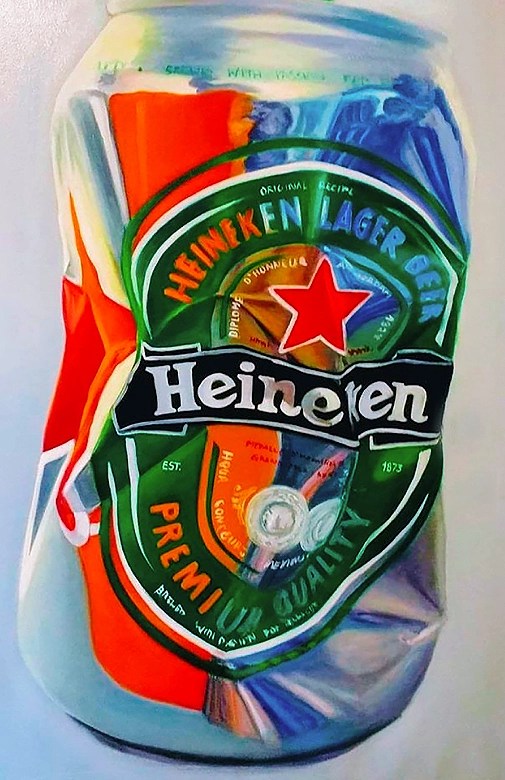
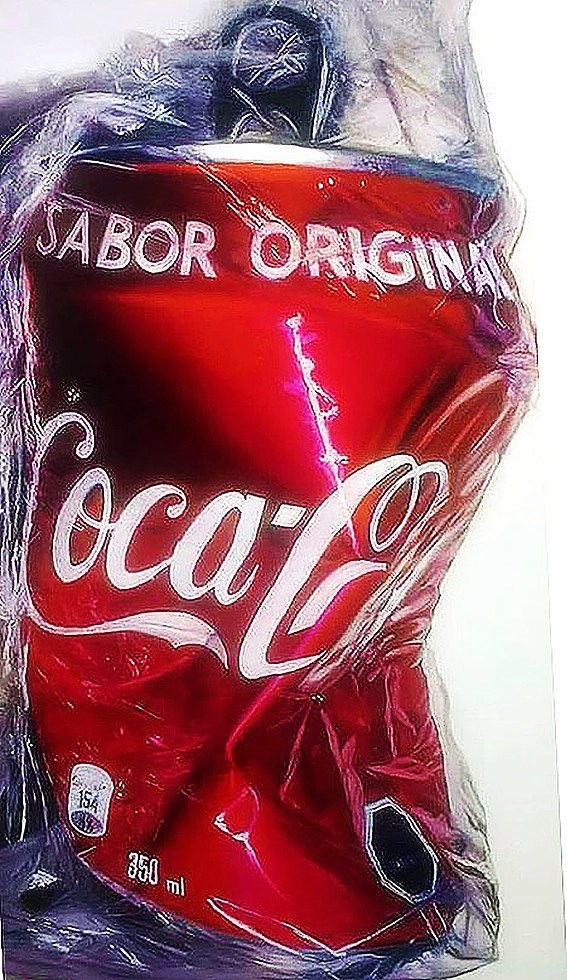
Oil on canvas
180×120
2018
Private collection
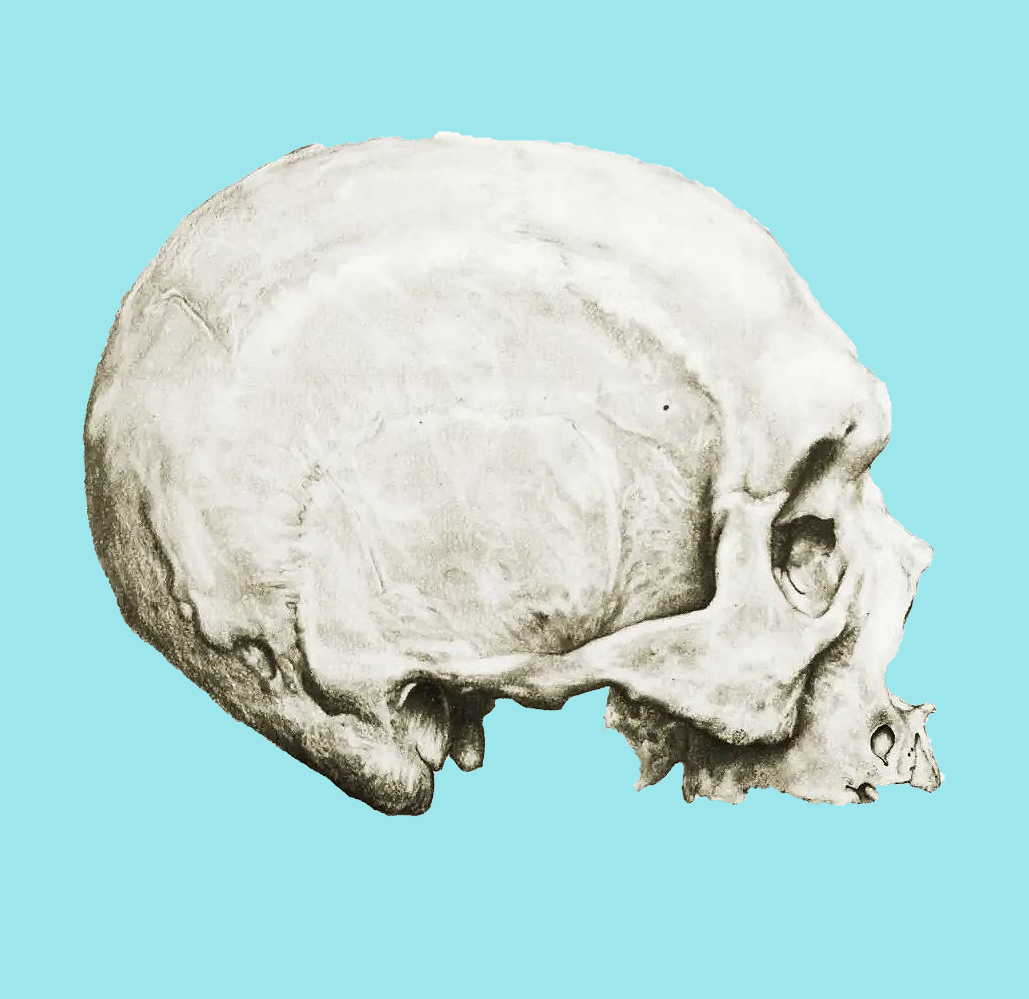
«The line consists of an infinite number of points; the plane, of an infinite number of lines; the volume, of an infinite number of planes; the hypervolume, of an infinite number of volumes… no, decidedly this more geometrico is not the best way to begin my story…»
— Jorge Luis Borges
Original¹: [ə’ridʒɪnl] 1. adj. (a) (first, earliest) original; (b) (not copied) original; (c) (unconventional) original; (: person) eccentric. 2. N (manuscript, painting, etc.) original; eccentric m/f.
Flavour²: [ˈfleɪvər] 1. n. (gen) flavor/savour; (flavoring) seasoning; condiment; (fig) flavor, tone. 2. Vt (Culin) to season.
Sabor³ [Flavor]: m. (lat. sapor). The effect certain things produce on the palate.
Original⁴: adj. (lat. originalis). That which is not an imitation of something else: an original painting. That which seems to have been produced for the first time: an original idea. One who writes or composes in a new way: an original writer. Strange, singular: an original character.
The Concept of the Solid
A solid is any body that occupies a place in space, composed of faces, dihedral angles, and dihedral vertices. The faces of a body can be basal or lateral. The lower basal face is understood as the supporting face of a body, and the upper basal face as its corresponding opposite, while the faces adjacent to the basal ones are termed lateral.
Geometric bodies are divided into Polyhedrons and Round Bodies. Round bodies—or bodies of revolution—are those bounded by curved faces or by a combination of flat and curved faces. The bodies of revolution are: the cylinder, the cone, and the sphere.
The Cylinder: A solid round body generated by the revolution of a rectangle. It is decomposed into a cylindrical mantle and two basal faces which are circles. When intercepted by a plane oblique to its base, it generates a cylindrical ellipse⁵.
«From scrap metal to the development of a jewel; from the waste of a mass-consumption product to the luxury of a pictorial work. A sublime alchemical exercise.«
The theoretical development of this composition can be divided into three thematic stages: Pop Art, Photorealism, and the Leitmotif.
Pop Art
Let us suppose, then, Pop Art not merely as a certain artistic movement, but fully as a subculture where new technologies, design, the consumer industry, and the mechanical industry—as well as the interrelations of these manifestations and their influence on human behavior—have served as the raw materials for several decades. The understanding of this framework will be the thematic starting point of Original Flavor: Pop Art as a consequence of the consumer industry and the modern life of societies.
Photorealism
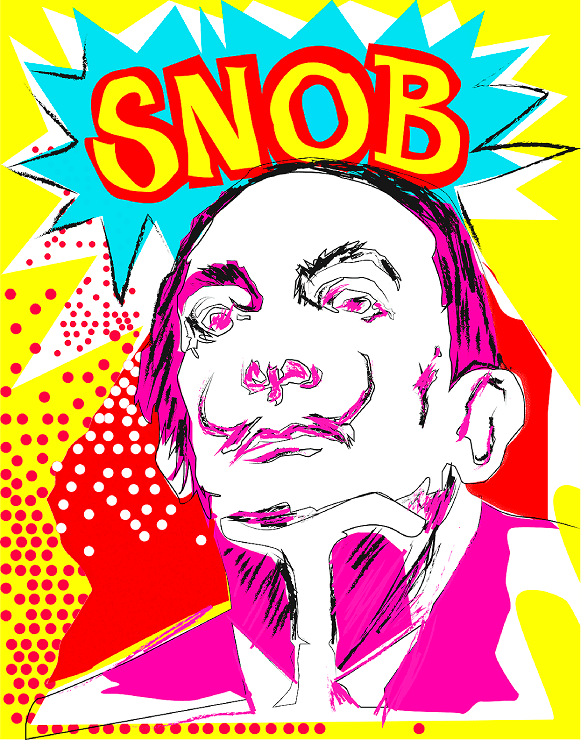
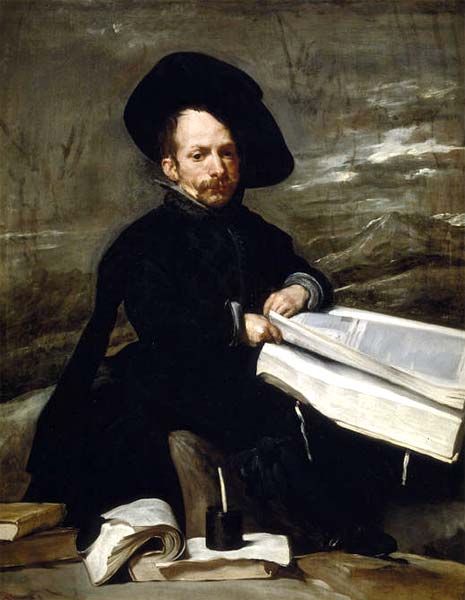
The second thematic axis observed in the composition is Photorealism. Dalí referred to Photorealism and Hyperrealism as the latest movements adopted by the Americans, speaking of this convergence between photography and painting in the history of art as avant-garde and ultra-figuration. He also commented, regarding the correct appreciation of the photorealistic method, that if a fool copied a photo, it would always result in foolishness; however, if Velázquez copied a photograph as best as he could, the result would be a «Velázquez.» Therefore, there was no need to worry about the degeneration of painting just because it was no longer the result of imagination or naturalistic figuration, for the painter’s personality is inseparable from their work.
Half a century has passed since Hyperrealism emerged as a genre in painting, yet to this day, naive newcomers appear, believing they are at the vanguard of painting by laboriously copying any idiotic image, thereby exposing their ignorance of pictorial iconographic tradition. By this, I mean that faithfully copying a full HD photograph is not enough for that merely artisanal and technical labor to reach the category of Fine Arts. This is precisely what Dalí intended to convey in those years.
Leitmotif
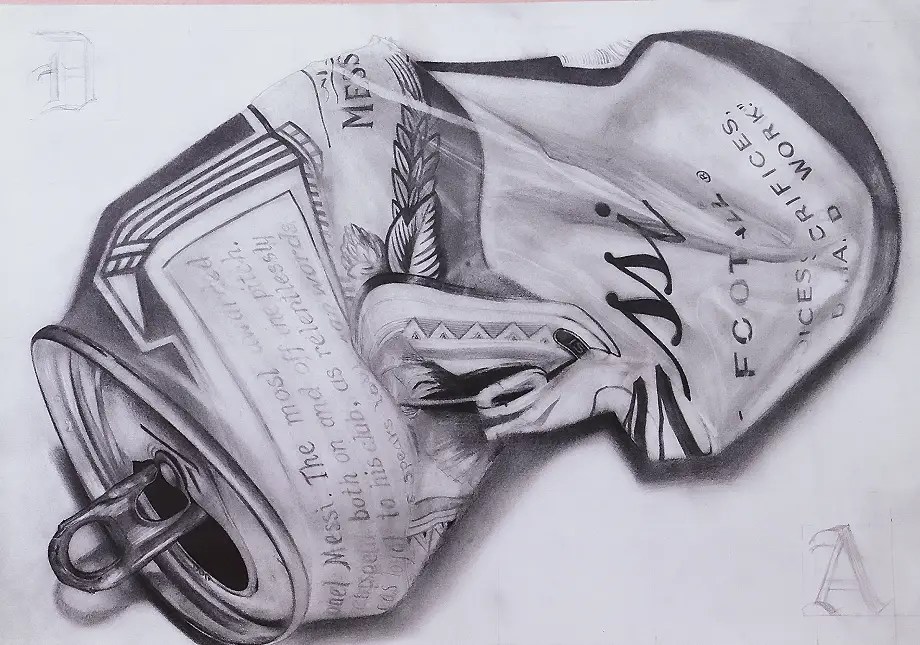
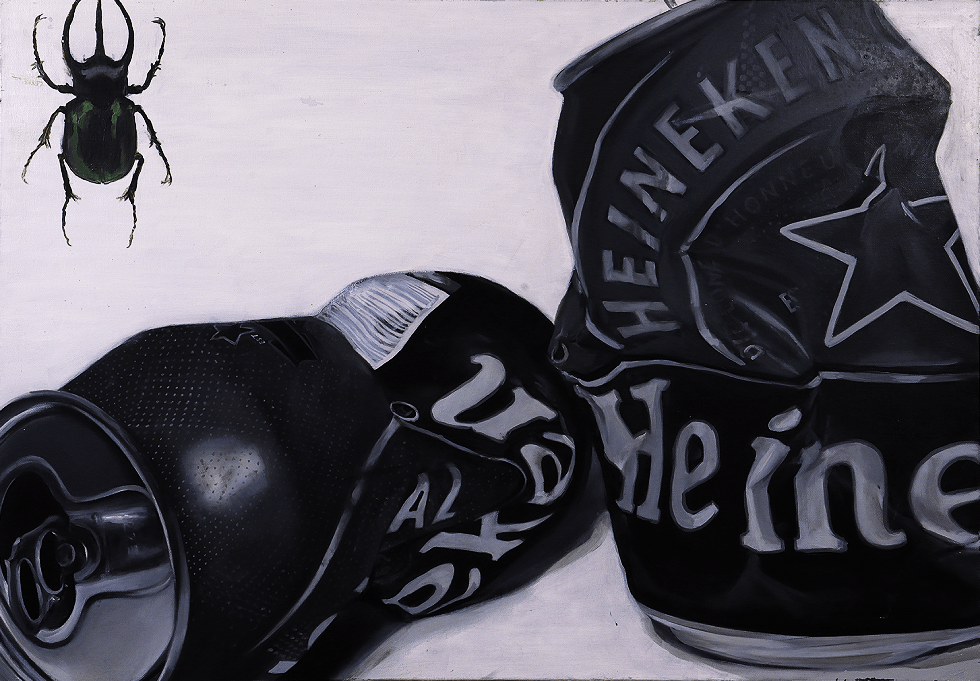
The third theoretical pillar upon which Original Flavor is based as a composition is the leitmotif. Aluminum or metals as elements to be represented have been a constant in Photo- and Hyperrealism since the movement’s inception and for several decades. Likewise, nylon and transparencies appear as the «stars» of this pictorial movement. The final element is the typographic passage within the composition, including the literal typography of a consumer brand.
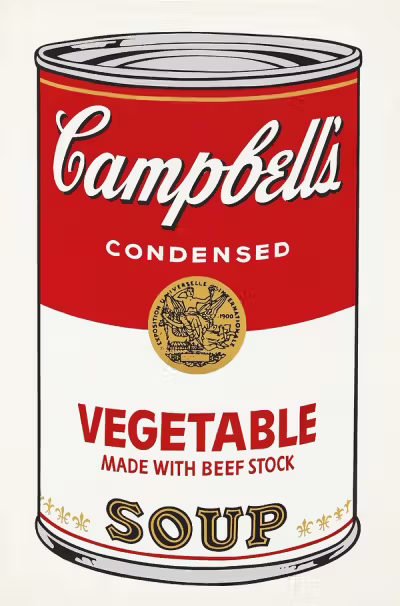
Consequently, a soda can constitutes a recurring motif in the pictorial genre of Hyperrealism. This play intends to be a new Campbell’s Soup—a reinterpretation of Warhol’s Campbell’s Soup—and it shall become the leitmotif of my photorealistic work starting from this painting.
All this intellectual play with clichés seeks to be a disdainful look at a genre so often abused and handled with such little grace or insight. Thus, design, advertising language, typography, and photography become servants to painting and its tradition. It is painting asserting itself in its noble tradition over the knowledge and languages of contemporary consumer society, acting as alchemy and a superior science. It is a vindication of painting and its supremacy; a superposition of thematic layers: Pop Art, Photorealism, and Leitmotif.
Daniel Adolfo Moreno, 2018
Original Flavour
«La línea consta de un número infinito de puntos, el plano de un número infinito de líneas; el volumen de un número infinito de planos, el hipervolumen, de un número infinito de volúmenes…no, decididamente no es éste, more geométrico, el mejor modo de iniciar mi relato…«
Jorge Luis Borges
Original1: [ə’ridƷinl] 1.adj(a) (first, earliest) original;(b) (not copied) original (c) (unconventional) original; (:person) excéntrico/ a. 2. N (manuscript, painting, etc) original m; excéntrico/a m/f.
Flavour2: (US) flavor [´fleivər] 1.n(gen) sabor m;(flavouring) condimento m; sazonamiento m(fig) sabor, tono m. 2. Vt (Culin) sazonar.
Sabor3: m. (lat. sapor). Efecto que produce en el paladar ciertas cosas.
Original4: adj. (lat. originalis). Que no es imitación de otra cosa: cuadro original. Que parece haberse producido por primera vez: idea original. Que escribe o compone de un modo nuevo: escritor original. Extraño, singular: carácter original
Concepto de sólido
Sólido es todo cuerpo que ocupa un lugar en el espacio, el cual está compuesto de caras, ángulos diedros y vértices diedros.
Las caras de un cuerpo pueden ser basales y laterales. Se entiende por cara basal inferior, a la cara de apoyo de un cuerpo, y cara basal superior, a la contraria correspondiente, denominándose laterales a las adyacentes de las basales.
Los cuerpos geométricos se dividen en Poliedros y Redondos. Los cuerpos redondos o de revolución son aquellos que están limitados por caras curvas o por caras planas y curvas.
Los cuerpos de revolución o redondos son: el cilindro, el cono y la esfera.
El Cilindro: es un cuerpo sólido redondo, generado por la revolución de un rectángulo. Se descompone en un manto cilíndrico y dos caras basales que son círculos. Al ser interceptado por un plano oblicuo a su base, genera una elipse cilíndrica5.
<<De la chatarra al desarrollo de una joya; del desecho de un producto de consumo masivo al lujo de una obra pictórica. Sublime ejercicio alquímico>>
El desarrollo teórico de esta composición puede dividirse en tres ejes temáticos: Arte pop, Fotorrealismo y el Leitmotiv.
Pop Art
Supongamos entonces Arte pop ya no sólo como cierto movimiento artístico sino plenamente como una subcultura donde las nuevas tecnologías, el diseño, la industria de consumo, la industria mecánica, como así también las interrelaciones de estas manifestaciones y su influencia sobre el comportamiento humano han sido las materias primas sobre las cuales ésta se ha servido por espacio de varias décadas, y va a ser entonces el entendimiento de todo esto el punto de partida temático de Original Flavor: el arte pop como consecuencia de la industria de consumo y la vida moderna de las sociedades.
Fotorrealismo
El segundo eje temático que apreciamos en la composición es el fotorrealismo. Dalí se refería al fotorrealismo e hiperralismo como el último movimiento adoptado por los americanos y hablaba de esta convergencia entre fotografía y pintura en la historia de la pintura como vanguardia y ultrafiguración. Comentaba también respecto de la correcta apreciación del método fotorrealista que si un tonto copiaba una foto le resultaría siempre una tontería, en cambio si Velázquez cobiaba una fotografía lo mejor que podía le resultaría un “Velázquez” y que por lo tanto no había de qué preocuparse con respecto a la degeneración de la pintura al no ser ya el resultado de la imaginación o la figuración naturalista de la realidad, porque la personalidad del pintor en su pintura es indisosiable. Ya pasó medio siglo desde que surgió el hiperrealismo como género tal en la pintura y hasta día de hoy aparecen ingenuos y advenedizos creyendo que están haciendo la vanguardia de la pintura copiando afanosamente cualquier idiotez de imagen, poniendo en evidencia su ignorancia respecto de la tradición iconográfica en la pintura. Quiero decir con esto que no basta con copiar fielmente una fotografía en full HD para que ese trabajo meramente artesanal y técnico alcance a la categoría de las bellas artes. Y era lo que Dalí también quería decir en esos años.
Lievmotiv
El tercer pilar teórico sobre el cual está basada Original flavour como composición es el leitmotiv. El aluminio o metales como elementos a representar es una constante en el foto e hiperrealismo de principios del movimiento y por espacio de varias décadas. También el nylon y las transparencias aparecen como vedete del movimiento pictórico; y el último elemento es el pasaje tipográfico dentro de la composición, incluso de la tipografía literal de una marca de un producto de consumo. Por lo tanto, la lata de una gaseosa constituye un motivo recurrente en el género pictórico del hiperrealismo. Este juego quiere ser una nueva Campbell soup, la reinterpretación de la Campbell soup de Warhol, y va a volverse en leitmotiv de mi obra fotorrealista a partir de esta pintura.
Todo este juego intelectual con los clichés quiere ser una mirada soberbia al género tan abusado y con tan poca gracia y acierto. Así, diseño, lenguaje publicitario, tipografía, fotografía vienen a ser servidores de la pintura y su tradición. Es la pintura enseñoreándose en su noble tradición por encima de estos saberes y lenguajes propios de la sociedad de consumo contemporánea como alquimia y ciencia superior. Es una reivindicación de la pintura y su supremacía de ésta, una superposición de estratos temáticos: arte pop, fotorrealismo y leitmotiv.
(Esta teorización fue desarrollada por el artista el mismo año de ejecución de la pintura: 2018)